 Innomerc
 One useful thing to do today
Use unique generated passwords and enable MFA.
More everyday safety lessonsChoose your depth. Learn at your own pace.
Understand it
A good password is difficult to guess and used for only one account. Reusing even a long password means a breach at one service can put other accounts at risk. A password manager can generate a different random password for every account.
Length gives randomly chosen secrets more possibilities. But a long familiar quote, repeated pattern or personal detail can still be predictable. Do not type a real password into a demonstration or an unfamiliar strength checker.
Under the hood
Guessing attacks differ. Online attempts can be rate limited by the service. Offline guessing happens against stolen password hashes and is constrained by the password distribution, hardware and the password-hashing algorithm. A character-count meter alone cannot measure those factors.
For uniformly random selections, each extra choice multiplies the search space. Human-generated strings are not uniform. Blocklists of common and compromised passwords, sufficient allowed length and support for password managers are more useful than arbitrary periodic changes.
Practitioner perspective
Assess password storage and recovery alongside authentication controls. Passwords should use an appropriate salted password-hashing scheme, never reversible storage for later retrieval. Parameters require measurement on the actual service.
Monitor repeated failures and compromised-credential signals while considering lockout abuse. After a breach, reset affected secrets and revoke relevant sessions. A password change does not necessarily invalidate every token the service previously issued.
Picture the idea: one account, one password
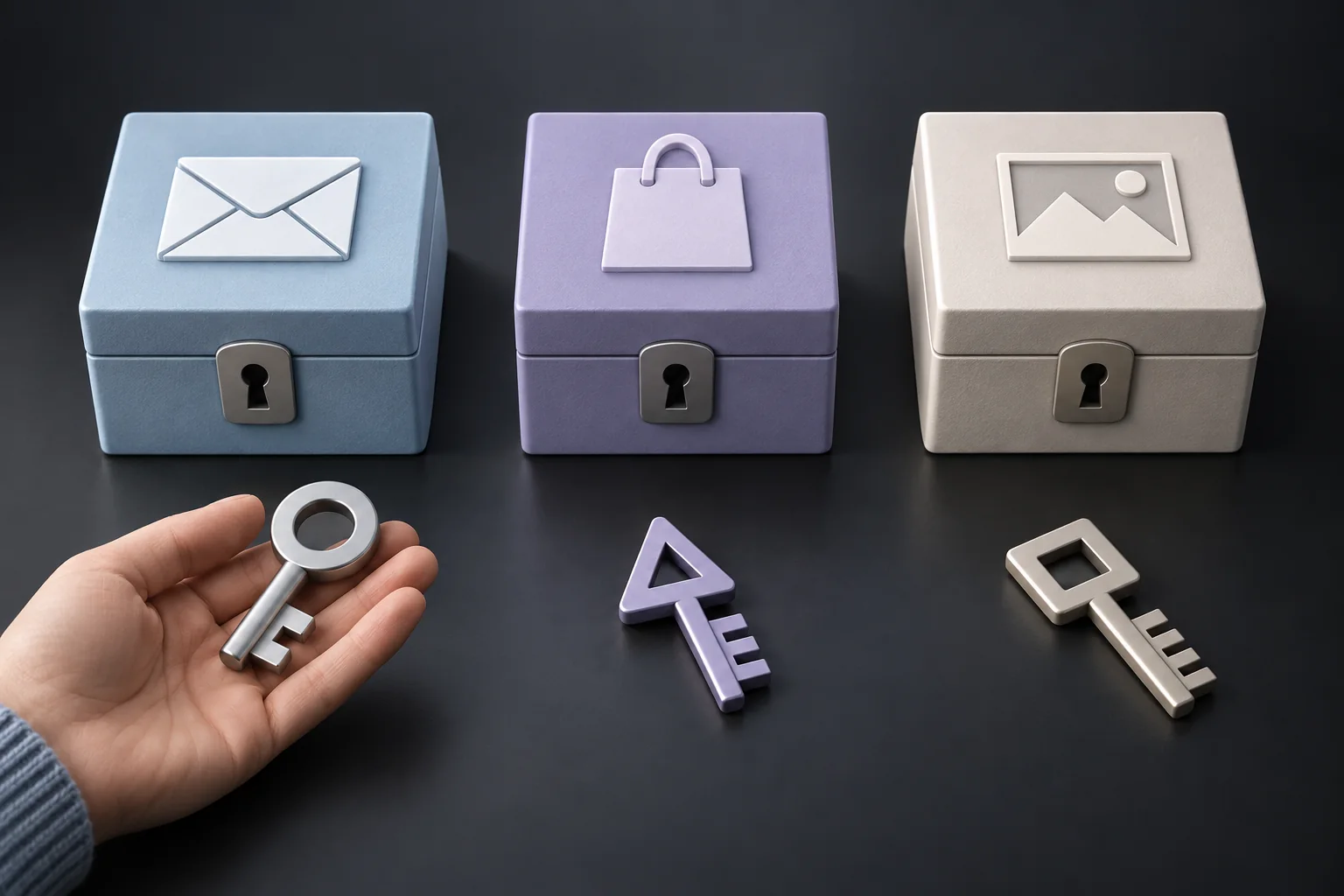
Different keys represent different passwords. A password exposed at one service should not unlock your other accounts. This illustrates uniqueness, not password strength or encryption.
Illustrated analogy · Select the image to enlargeWatch it work
A fictional, simplified model. Select a component to inspect it, or follow the steps in order.
One password leak, two different outcomes
Watch the difference between reusing a password and using separate secrets.
One exposed secret can be tried at another service where you reused it.
How to use this example
Select Next step to read at your own pace, or Animate step to watch one exchange. Nothing advances until you choose.
What it means
Everyday example
State in this scenario
Inspect components & read every step
- Shopping account
An account used with a shopping service.
Example: If its password is reused elsewhere, one leak can affect more accounts.
- Someone else
A different person trying to use credentials in this scenario.
Example: They try a leaked shopping password on another account.
- Your email
Your email account, which may also receive password-reset messages.
Example: Protecting it helps prevent someone using reset links to reach other accounts.
Same password
One exposed secret can be tried at another service where you reused it.
- Shopping account Someone else: Exposed secret. A fictional shop password becomes known to someone else.
- Someone else Your email: Same secret. The same password is tried against your email account.
- Your email Someone else: Access risk. Without another effective check, the account may issue a session.
Different passwords
A password unique to the shop is not the valid password for your mailbox.
- Shopping account Someone else: Exposed secret. The shop password becomes known to someone else.
- Someone else Your email: Wrong secret. Your mailbox uses an unrelated password.
- Your email Someone else: Rejected. The exposed password does not pass this sign-in check.
Fictional teaching trace. One moving dot represents an exchange, not a measured network capture.
Open the detailed lesson walkthrough
Explore the system
One breach
A password for fictional Shop A is exposed.
Read every step without animation
Reused secret
- One breach. A password for fictional Shop A is exposed.
- Second account. The same password also protects Cedar Mail.
- Shared risk. Both accounts now need attention.
Uniqueness limits how far one stolen password can travel.
Unique secrets
- One breach. Shop A’s password is exposed.
- Different password. Cedar Mail uses a different generated secret.
- Contained reuse risk. The exposed secret does not authenticate to Cedar Mail.
Other attacks remain possible; add MFA.
What could go wrong
Credential reuse lets a password exposed at one fictional service be tried against a second service. No password entry or cracking occurs in this visual.
What you can do
- Use unique generated passwords and enable MFA.
- Choose a long, memorable master passphrase and protect its recovery.
- Change a password when compromised or exposed; do not rely on predictable rotations.
Common mistakes
- Adding “!” to a common password does not remove its predictability.
- A password is not safe merely because a meter says strong.
Check your understanding
Active recall: explain this idea in 30 seconds
A good password is difficult to guess and used for only one account. Reusing even a long password means a breach at one service can put other accounts at risk. A password manager can generate a different random password for every account.
Now give an example and name one limitation. Revisit the explanation if you get stuck.
Primary sources
Original explanations informed by these specifications and official resources. Source versions and lesson review are separate from product updates.
Content reviewed 2026-09-10. Read the editorial policy.