 Innomerc
 One useful thing to do today
Replace reused passwords with unrelated generated ones.
More everyday safety lessonsChoose your depth. Learn at your own pace.
Understand it
A password leak at one service can affect other accounts if you reused the same password. Adding a year or changing one letter often creates a predictable variation.
Start with your email, bank and password manager. Give each a unique password, then work through other reused accounts. A password manager can create and remember different passwords for you.
Under the hood
Credential stuffing tests previously exposed username/password pairs at other services. It differs from guessing one password at a time without prior breach data. Uniqueness breaks that direct reuse route; session theft and phishing remain separate risks.
Practitioner perspective
Layer breached-password screening, rate controls, anomaly review and secure recovery. Avoid account lockout designs that let attackers deny service cheaply. Count verified takeover outcomes rather than equating every failed login with an incident.
Picture the idea: one account, one password
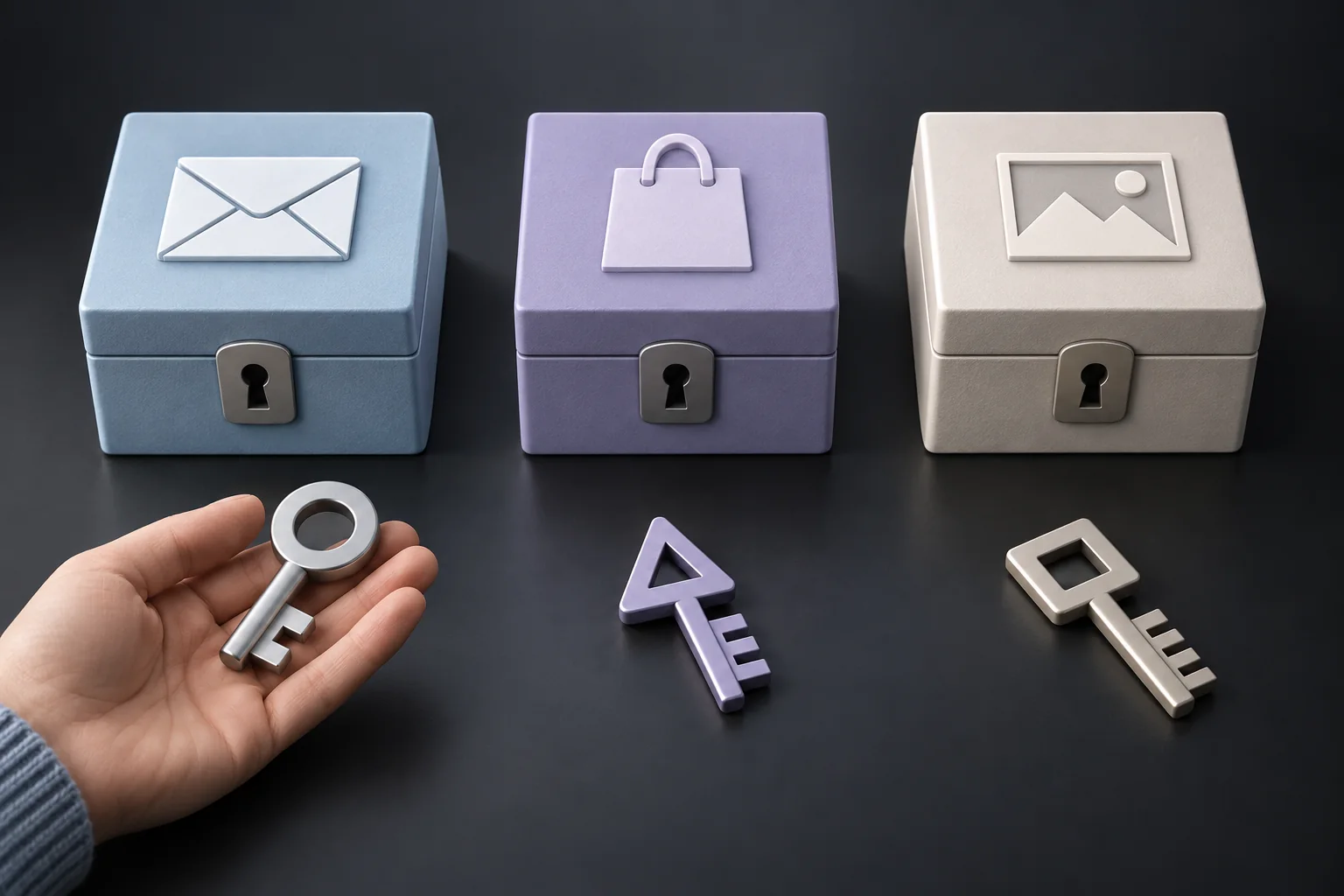
Different keys represent different passwords. A password exposed at one service should not unlock your other accounts. This illustrates uniqueness, not password strength or encryption.
Illustrated analogy · Select the image to enlargeWatch it work
A fictional, simplified model. Select a component to inspect it, or follow the steps in order.
One password leak, two different outcomes
Watch the difference between reusing a password and using separate secrets.
One exposed secret can be tried at another service where you reused it.
How to use this example
Select Next step to read at your own pace, or Animate step to watch one exchange. Nothing advances until you choose.
What it means
Everyday example
State in this scenario
Inspect components & read every step
- Shopping account
An account used with a shopping service.
Example: If its password is reused elsewhere, one leak can affect more accounts.
- Someone else
A different person trying to use credentials in this scenario.
Example: They try a leaked shopping password on another account.
- Your email
Your email account, which may also receive password-reset messages.
Example: Protecting it helps prevent someone using reset links to reach other accounts.
Same password
One exposed secret can be tried at another service where you reused it.
- Shopping account Someone else: Exposed secret. A fictional shop password becomes known to someone else.
- Someone else Your email: Same secret. The same password is tried against your email account.
- Your email Someone else: Access risk. Without another effective check, the account may issue a session.
Different passwords
A password unique to the shop is not the valid password for your mailbox.
- Shopping account Someone else: Exposed secret. The shop password becomes known to someone else.
- Someone else Your email: Wrong secret. Your mailbox uses an unrelated password.
- Your email Someone else: Rejected. The exposed password does not pass this sign-in check.
Fictional teaching trace. One moving dot represents an exchange, not a measured network capture.
Open the detailed lesson walkthrough
Explore the system
Shop leak
One password becomes known.
Read every step without animation
Same password
- Shop leak. One password becomes known.
- Mail sign-in. The same secret is tried elsewhere.
- Wider access. The mailbox may open too.
One exposure crosses account boundaries.
Different passwords
- Shop leak. Only the shop secret is exposed.
- Mail sign-in. Mail has a different secret.
- Reuse blocked. That exposed pair does not open mail.
Unique passwords limit this particular chain.
What could go wrong
A fictional shop leaks a password that also opens a customer’s mailbox.
What you can do
- Replace reused passwords with unrelated generated ones.
- Enable MFA and secure the email used to reset other accounts.
Common mistakes
- A long reused password still creates shared risk.
- Regularly changing only its last digit does not create independent secrets.
Check your understanding
Active recall: explain this idea in 30 seconds
A password leak at one service can affect other accounts if you reused the same password. Adding a year or changing one letter often creates a predictable variation.
Now give an example and name one limitation. Revisit the explanation if you get stuck.
Primary sources
Original explanations informed by these specifications and official resources. Source versions and lesson review are separate from product updates.
Content reviewed 2026-09-10. Read the editorial policy.