 Innomerc
 Choose your depth. Learn at your own pace.
Understand it
A SIEM brings security-relevant events together so people can search, correlate and investigate them. A log is a record of something that happened. An alert is a signal that a condition deserves attention. An incident is a conclusion requiring context, not simply another word for an alert.
Cedar’s identity service records a login and its endpoint records a new process. Looking at both can answer questions that either source alone cannot. The SIEM helps connect evidence, but it cannot observe events that were never collected.
Under the hood
Collection brings events from endpoints, applications, networks and cloud services into a processing pipeline. Parsing and normalization extract fields such as timestamp, user, host and action. Detection logic queries or correlates those fields under explicit assumptions.
Time zones, duplicate events, parser changes and missing identifiers can change the meaning of a correlation. An event’s arrival time is not always its occurrence time. Preserve enough original context to investigate parsing mistakes.
Practitioner perspective
Treat detections as maintained products with owners, data requirements, test cases and tuning history. Measure telemetry health and analyst outcomes alongside alert volume. A quieter alert queue may mean improved precision or lost visibility.
During triage, state a hypothesis and seek evidence that could disprove it. Enrich with asset role, identity history and relevant intelligence. Escalate based on impact and confidence, and retain a clear record of why the conclusion changed.
SIEM
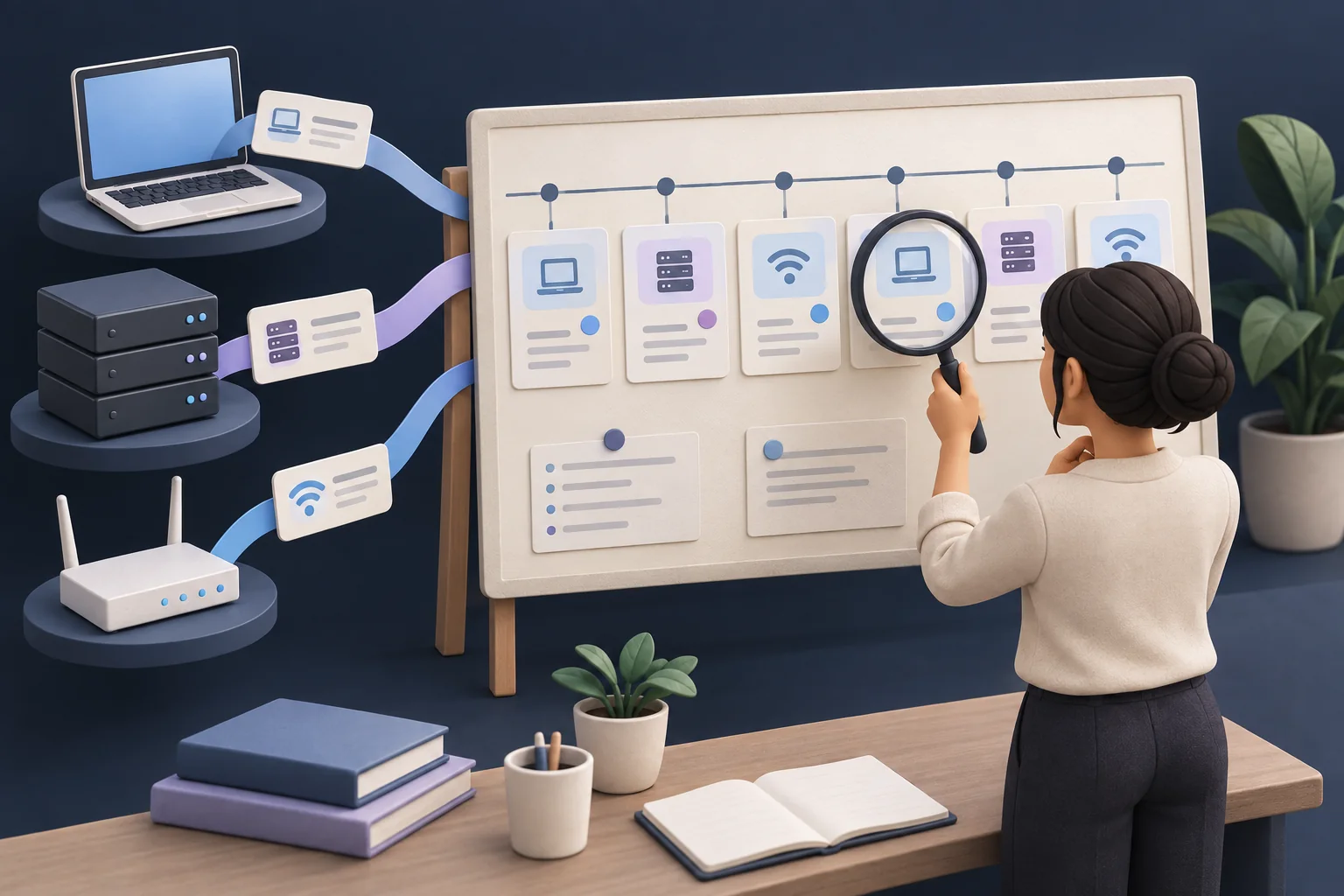
A SIEM brings security-relevant events together so people can search, correlate and investigate them. A log is a record of something that happened. An alert is a signal that a condition deserves attention. An incident is a conclusion requiring context, not simply another word for an alert.
Illustrated analogy · Select the image to enlargeWatch it work
A fictional, simplified model. Select a component to inspect it, or follow the steps in order.
Explore the system
Log sources
Identity and endpoint systems produce events.
Read every step without animation
Event to investigation
- Log sources. Identity and endpoint systems produce events.
- Normalize. Fields and timestamps become searchable.
- Correlate. A rule links relevant events under a defined hypothesis.
- Alert. The result enters an owned triage queue.
- Investigate. An analyst checks context and competing explanations.
An alert starts a question; evidence supports the answer.
Attack view
A fictional unusual sign-in is followed by an unexpected process on the same user’s device. This combination prompts investigation; it does not automatically establish malicious intent.
Defender view
- Monitor collection gaps, parsing failures and clock alignment.
- Version detection logic and test known positive and negative cases.
- Assign alert ownership and maintain a usable investigation workflow.
Common mistakes
- A SIEM does not automatically detect every attack.
- More alerts do not necessarily mean better security.
Check your understanding
Active recall: explain this idea in 30 seconds
A SIEM brings security-relevant events together so people can search, correlate and investigate them. A log is a record of something that happened. An alert is a signal that a condition deserves attention. An incident is a conclusion requiring context, not simply another word for an alert.
Now give an example and name one limitation. Revisit the explanation if you get stuck.
Primary sources
Original explanations informed by these specifications and official resources. Source versions and lesson review are separate from product updates.
Content reviewed 2026-09-10. Read the editorial policy.